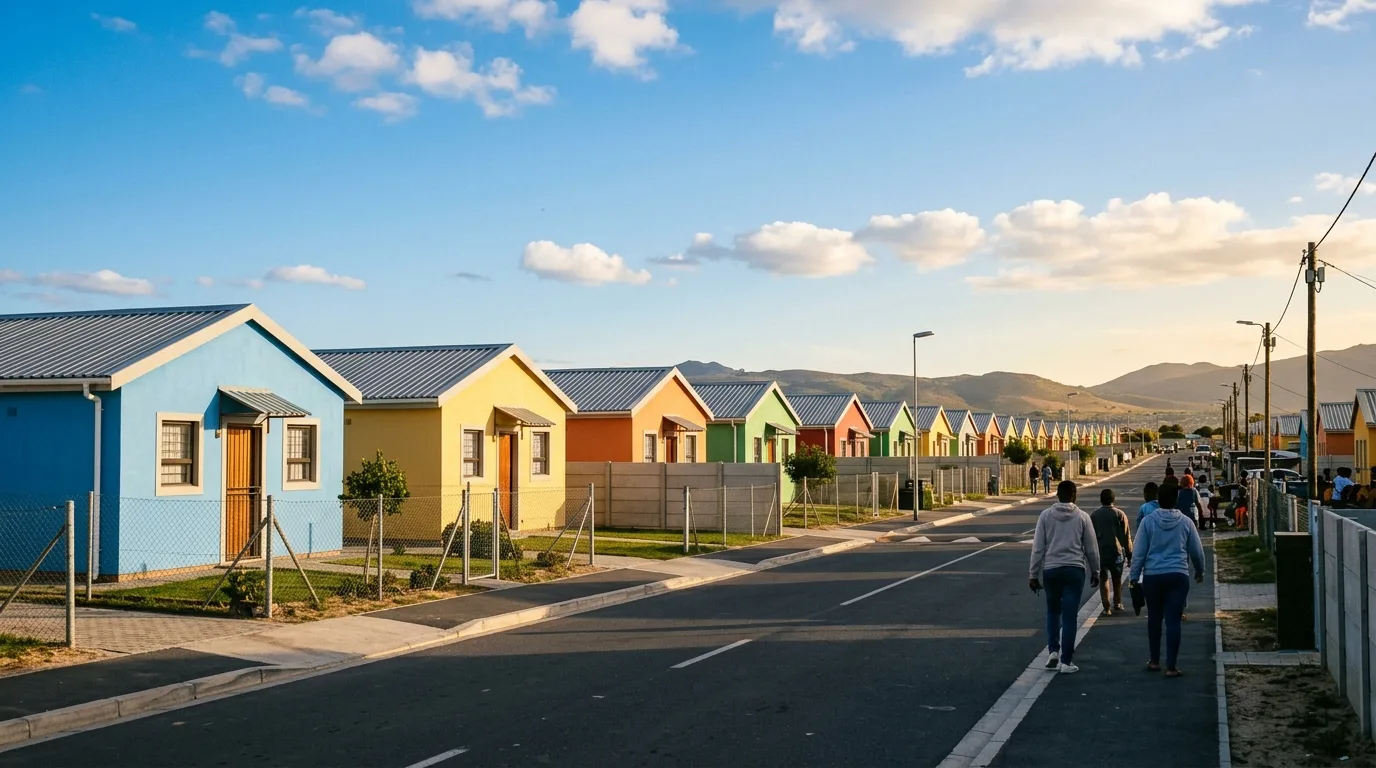
Housing remains one of the most pressing challenges in South Africa. With a national backlog of over 2.3 million households on waiting lists, the government runs two core programmes to help citizens access adequate shelter: the Reconstruction and Development Programme (RDP) for low-income households, and the Finance Linked Individual Subsidy Programme (FLISP) for middle-income earners who can afford a home loan but need help with the deposit.
Both programmes are managed by the Department of Human Settlements, but they work very differently. Understanding which one you qualify for - and what the realistic timeline looks like - can save you years of frustration and protect you from the housing scams that continue to plague communities across the country.
RDP Housing: Who Qualifies and What You Get
The RDP housing programme provides fully subsidised, free houses to qualifying South African households. The government funds the land, construction, and basic services connection. Recipients pay nothing for the house itself, though they remain responsible for municipal rates and utilities once they move in.
A standard RDP house is a freestanding unit of 40 to 50 square metres, typically consisting of two bedrooms, an open-plan living and kitchen area, and a bathroom. Each unit is delivered with a water connection, electricity connection, and basic sanitation. The house is built on a serviced stand that is transferred into the beneficiary's name.
To qualify for an RDP house in 2026, you must meet all of the following criteria:
1. South African citizen or permanent resident. You must hold a valid South African ID document. Temporary residents and asylum seekers do not qualify.
2. Age requirement. You must be 21 years or older, or younger than 21 if you are married or have financial dependants.
3. Household income below R3,500 per month. This is the combined gross income of you and your spouse or partner. If your total household income exceeds R3,500, you fall into FLISP territory instead.
4. First-time government housing beneficiary. Neither you nor your spouse may have previously received a government housing subsidy or owned a residential property.
5. You must have dependants. Single people without children generally do not qualify unless they are over 60, have a disability, or have other recognised dependants.
Title Deed Restriction
RDP houses come with a title deed restriction that prevents you from selling the property for eight years after transfer. This is designed to stop beneficiaries from flipping houses and ending up homeless again. After eight years, the restriction lifts and the house is yours to sell on the open market.
FLISP Subsidy: The Middle-Income Option
FLISP targets households that earn too much for an RDP house but too little to comfortably afford a home loan on their own. Rather than providing a free house, FLISP gives you a once-off cash subsidy that is paid directly toward your home purchase - typically used to reduce the deposit or lower the loan amount.
FLISP is available to households with a combined gross monthly income of R3,501 to R22,000. The subsidy amount is inversely proportional to your income: the less you earn, the larger the subsidy. The 2026 subsidy brackets are as follows:
| Monthly Household Income | Subsidy Amount |
|---|---|
| R3,501 – R7,000 | R130,505 |
| R7,001 – R10,000 | ~R110,000 |
| R10,001 – R15,000 | ~R70,000 |
| R15,001 – R22,000 | R27,960 |
The property you purchase with FLISP must be a completed, habitable residential unit. You can buy a house, townhouse, or sectional title unit, but you cannot use FLISP for vacant land or a property under construction (unless it is a turnkey development registered with the NHFC). The purchase price has no fixed ceiling, but in practice FLISP works best for properties in the R300,000 to R600,000 range.
For detailed eligibility criteria and application steps, see our full FLISP guide.
FLISP Is Significantly Faster Than RDP
Because FLISP does not require the government to build a house, the turnaround is much shorter. Once your home loan is approved and you have found a qualifying property, the FLISP subsidy can be processed in 3 to 6 months. Compare this with RDP waiting times of 10 years or more in major metros.
How to Apply: Step by Step
The application process differs depending on which programme you are applying for. Here is how each one works in practice.
Applying for an RDP house:
Step 1: Visit your local municipal housing office. This is not a national or online process. You must physically go to the housing department of your municipality (city or district) and request to be placed on the waiting list.
Step 2: Register on the National Housing Needs Register. The housing office will capture your details, including your ID, proof of income, number of dependants, and current living conditions. You will receive a reference number.
Step 3: Wait for allocation. The municipality allocates houses as they are built, following the waiting list order. Priority is given to the elderly, people with disabilities, households headed by women, and military veterans. Your position on the list determines your wait time.
Applying for a FLISP subsidy:
Step 1: Get pre-approved for a home loan from any registered bank (ABSA, Standard Bank, FNB, Nedbank, Capitec, or African Bank). The bank assesses whether you can service the monthly bond repayment.
Step 2: Find a qualifying property within your affordability range. You can use an estate agent or search independently.
Step 3: Once you have a signed offer to purchase, your bank or the National Housing Finance Corporation (NHFC) submits the FLISP application on your behalf. You will need your ID, proof of income, bank statements, and the signed sale agreement.
Step 4: The subsidy is approved and paid directly to the transferring attorney as part of the property transfer. You do not receive the money in your bank account.
Beware of Agents Charging Application Fees
Neither RDP nor FLISP applications carry any government fees. If someone charges you money to "place you on the housing list" or "fast-track your FLISP application," you are dealing with a scam. Municipal housing offices do not charge for registration, and FLISP applications are processed through your bank at no cost to you. Report any such requests to the National Anti-Corruption Hotline: 0800 701 701.
Realistic Waiting Times in 2026
The national RDP housing backlog stands at approximately 2.3 million households as of the 2025/26 financial year. Delivery rates have slowed due to budget constraints, land acquisition challenges, and municipal capacity issues. The result is waiting times that vary dramatically depending on where you live.
The following table provides estimated waiting times by province. These are based on current delivery rates and backlog data from the Department of Human Settlements. Individual experiences will vary depending on the specific municipality and your position on the list.
| Province | RDP Estimate | FLISP Estimate |
|---|---|---|
| Gauteng | 12 – 15+ years | 3 – 6 months |
| Western Cape | 10 – 15+ years | 3 – 6 months |
| KwaZulu-Natal | 8 – 12 years | 3 – 6 months |
| Eastern Cape | 6 – 10 years | 3 – 5 months |
| Limpopo | 5 – 8 years | 3 – 5 months |
| Mpumalanga | 4 – 7 years | 3 – 5 months |
| Free State | 4 – 7 years | 3 – 5 months |
| North West | 3 – 6 years | 3 – 5 months |
| Northern Cape | 2 – 5 years | 3 – 4 months |
The difference between RDP and FLISP timelines is stark. RDP requires the government to acquire land, appoint contractors, build houses, and install bulk infrastructure - a process that is constrained by annual budgets and political priorities. FLISP, by contrast, rides on the existing private property market. As long as the banks are lending and properties are available, the subsidy can be processed in months rather than years.
Housing List Scams Are on the Rise
Fraudsters operate in communities across South Africa, promising to move people up the RDP waiting list in exchange for payment. Common tactics include fake "housing agents" who collect deposits, WhatsApp groups circulating lists of "available houses," and people impersonating municipal officials. No one can sell you a position on the housing list. If you suspect fraud, report it to SAPS or call the Human Settlements fraud line at 0800 701 701.
SASSA Recipients and Housing
If you receive a SASSA social grant, you almost certainly fall within the RDP income bracket. The highest individual grant - the Older Person's Grant at R2,420 per month for those over 75 - is well below the R3,500 household income ceiling. Even a household with two grant recipients would typically qualify.
Grant income is counted as part of your household income for housing assessment purposes, but because the amounts are low, this works in your favour. SASSA recipients are among the primary intended beneficiaries of RDP housing.
There is also a direct link between housing and municipal services. Once you are registered as an indigent household (which most SASSA-only households qualify for), you become eligible for Free Basic Services - including free water (6,000 litres per month), free electricity (50 kWh per month), and free refuse removal. For a full breakdown of what you can access, see our Free Basic Services guide.
If you are an SRD grant recipient living in informal housing, you should register on the National Housing Needs Register even if the waiting times seem discouraging. Being on the list is a prerequisite for allocation, and municipalities sometimes accelerate delivery in areas with high concentrations of registered applicants.
Combine Housing Registration with Indigent Registration
When you visit your municipal office to register for housing, ask to be placed on the indigent register at the same time. This unlocks Free Basic Services and may also exempt you from property rates once you receive your RDP house. It is a single trip that secures two important benefits.
Common Rejection Reasons
Applications for both RDP and FLISP are rejected more often than many people realise. Understanding the common reasons can help you avoid delays and wasted effort.
1. You already own property. The Housing Subsidy System (HSS) database is cross-checked with the Deeds Office. If you or your spouse own any residential property - even an inherited one - your application will be declined. You must first dispose of the existing property before reapplying.
2. You received a previous housing subsidy. Government housing assistance is a once-in-a-lifetime benefit. If you received an RDP house, FLISP subsidy, or any other form of government housing assistance at any point in the past, you are permanently excluded from both programmes.
3. Income exceeds the threshold. For RDP, any household income above R3,500 disqualifies you. For FLISP, the ceiling is R22,000. Income is verified through payslips, UIF records, and sometimes SARS data. Understating your income is considered fraud.
4. Incomplete or incorrect documentation. Missing ID copies, unsigned affidavits, outdated proof of income, or incorrect banking details are the most common administrative reasons for rejection. Always bring certified copies and ensure all documents are current.
5. Not on the waiting list. You cannot receive an RDP house if you are not registered on the National Housing Needs Register. Some people assume that living in an informal settlement automatically qualifies them. It does not - you must actively register.
If your application is rejected, you have the right to appeal through the provincial Department of Human Settlements. The appeal must be lodged within 30 days of receiving the rejection notice. You can also approach the provincial housing tribunal for a formal review of your case.
Key Contacts for Housing Assistance
- Your municipal housing office - first point of contact for registration and status checks
- Provincial Department of Human Settlements - for appeals and escalations
- National Housing Finance Corporation (NHFC) - for FLISP queries: 0800 394 345
- National Anti-Corruption Hotline - to report housing fraud: 0800 701 701