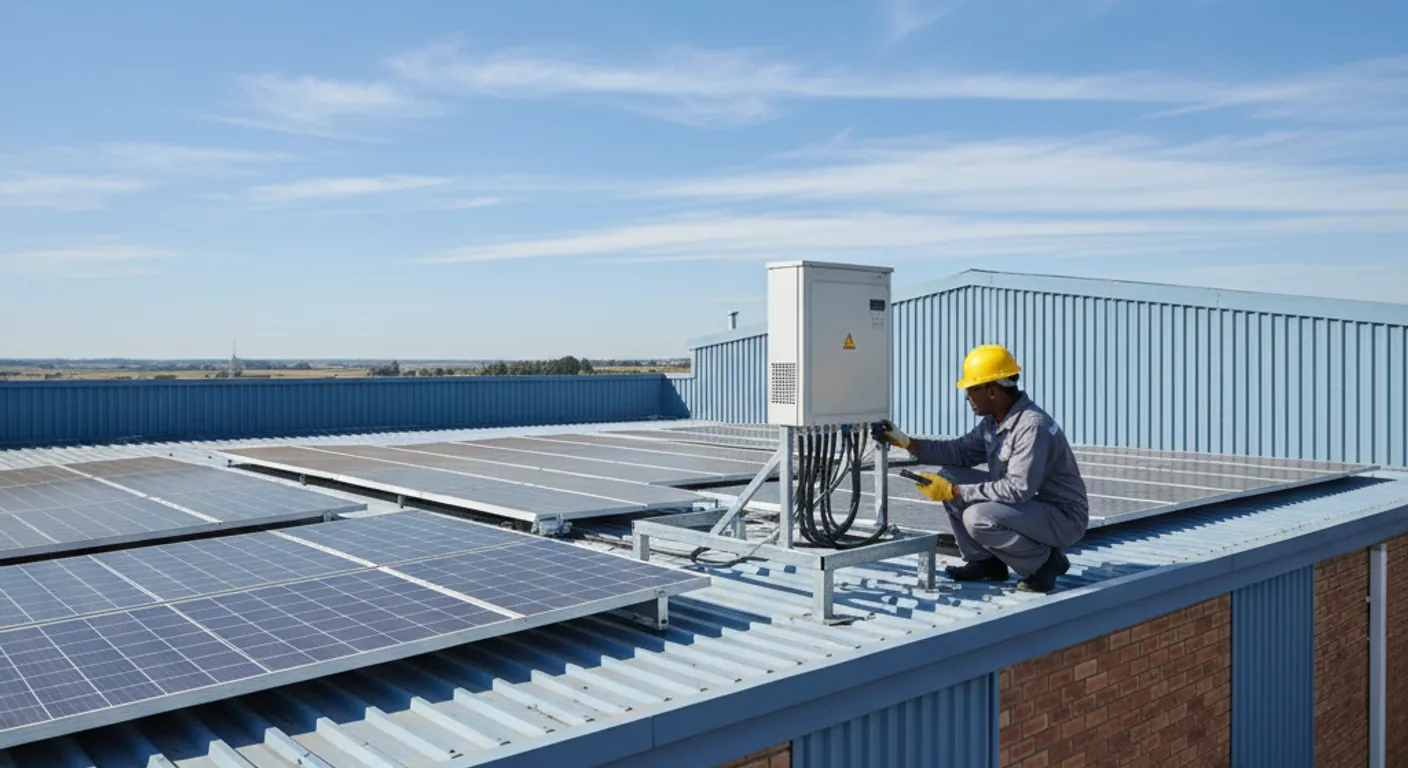
For two years, Section 12BA gave South African businesses installing renewable energy an enhanced 125% deduction in the year of commissioning. The policy did its job: rooftop solar installations on commercial premises roughly doubled between March 2023 and February 2025. Then the window closed.
Now, in the 2026 tax year, SMME owners considering rooftop PV are asking a sensible question: with the bonus gone, is solar still worth installing from a pure tax perspective? The short answer is yes. The longer answer requires untangling three overlapping pieces of legislation, two expired incentives, and one widely misunderstood rule about what counts as "used in the production of income".
The 2026 Incentive Landscape in One Page
Three renewable energy tax incentives have been in play since 2023. Only one now applies to SMMEs installing rooftop solar.
| Incentive | Who | Rate | Status in 2026 |
|---|---|---|---|
| Section 12B | Companies, trusts, sole props using asset for income | 100% year 1 (solar PV) | Active |
| Section 12BA | Companies installing renewables | 125% year 1 | Expired 28 Feb 2025 |
| Section 6C | Individual taxpayers (residential solar) | 25% rebate, max R15,000 | Expired 29 Feb 2024 |
For a small business installing rooftop solar today, only Section 12B is on the table. But 12B is more generous than most SMME owners realise.
How Section 12B Actually Works in 2026
Section 12B of the Income Tax Act permits a taxpayer to deduct the full cost of a qualifying renewable energy asset from taxable income in the year the asset is brought into use. For solar PV, this is a 100% year-one write-off. There is no accelerated tapering over three years any more; the old 50/30/20 schedule no longer applies to PV.
Three conditions have to be met. First, the asset must be owned by the claimant, not leased (although certain finance leases qualify). Second, it must be brought into use during the tax year, meaning commissioned and producing electricity. Third, the electricity must be used in the production of income, which for an SMME typically means powering the premises where the business operates.
What "Production of Income" Means in Practice
SARS interprets this broadly for commercial premises. If your solar powers a shop, workshop, warehouse, office, or guesthouse where you run a business, it qualifies. If the same system also powers a residential flat above the shop, you typically have to apportion the cost between business and private use. Most SMMEs err toward claiming 100% and wait for SARS to query it. A better approach is to calculate a defensible business-use percentage upfront.
A Worked Example for a R400,000 Installation
Consider a plumbing business operating as a Pty (Ltd) with R1.2 million in annual taxable income. The owner installs a rooftop solar system on the workshop for R400,000 (panels, inverter, lithium battery, installation, and compliance certificates).
| Line Item | Before Solar | After Solar (Year 1) |
|---|---|---|
| Taxable income | R1,200,000 | R1,200,000 |
| Section 12B deduction | R0 | R400,000 |
| Adjusted taxable income | R1,200,000 | R800,000 |
| Corporate tax at 27% | R324,000 | R216,000 |
| Tax saved in year 1 | – | R108,000 |
In this example, the 12B deduction produces an effective tax saving of R108,000 in the year of installation. That reduces the net cost of the R400,000 system to R292,000, before counting any electricity bill savings or backup-power value during load-shedding.
Under 12BA It Would Have Been Higher
Under the lapsed Section 12BA, the same R400,000 install would have produced a R500,000 deduction (125%), saving R135,000 in year-one tax. So the end of 12BA costs this specific SMME R27,000 in incremental benefit. Not negligible, but far from the reason to abandon a solar project.
What About Batteries and Generators?
Batteries installed alongside solar PV generally qualify under 12B because they form part of the renewable energy generation asset. Standalone batteries installed without solar, however, sit in a grey area. SARS binding ruling 231 (withdrawn in 2023 and not yet replaced) previously allowed standalone battery backup to qualify; the current position is case-by-case.
Diesel generators do not qualify. Neither does gas, petrol backup, or any asset that burns fossil fuels. If you buy a hybrid system that combines solar with a standby diesel generator, the diesel portion has to be depreciated under the standard Section 11(e) wear-and-tear rules over the useful life of the asset.
The VAT Piece Most SMMEs Miss
If your business is a VAT vendor, the input VAT on a solar installation is fully recoverable in the same tax period the invoice is issued, provided the installation is used to make taxable supplies. On a R400,000 installation (VAT-exclusive), that is R60,000 in input VAT claimable via the VAT201 return.
Combined with the 12B deduction, the true net cost for a VAT-registered SMME in this example drops to around R232,000 for a system nominally priced at R460,000 VAT-inclusive. That is a 50% effective rebate assembled from two separate tax mechanisms.
Claim VAT and Section 12B in the Same Year
The two incentives do not overlap. VAT is reclaimed on the VAT201 within one to two months of installation. The 12B deduction goes on the company's annual IT14 return. Both can be claimed for the same install, in the same tax year, without reducing either benefit.
Stacking With Grants
Some SMMEs also qualify for grant funding that covers a portion of the solar install cost. The most relevant for small businesses is the EEDSM (Energy Efficiency and Demand Side Management) programme and, for agriculture, the Agro Energy Fund.
If a grant covers, say, R100,000 of a R400,000 install, you can only claim the Section 12B deduction on the R300,000 you actually paid from your own funds. The grant portion is excluded because it does not form part of your tax cost base. This is the most common SARS audit finding on solar-with-grant arrangements - businesses forget to net off the grant and end up repaying tax with penalties.
Should SMMEs Still Install in 2026?
From a narrow tax perspective, Section 12B on its own is strong enough to make rooftop solar financially sensible for any SMME with consistent taxable income, a building they control, and a realistic path to using the electricity for income-producing activities. The disappearance of 12BA is a real loss of roughly 7% effective tax benefit on the install cost, but not a deal-breaker.
The install is most compelling for businesses that are:
- Consistently profitable at the 27% corporate rate (not in assessed-loss position)
- Registered for VAT
- Owner-occupying their commercial premises
- Running high daytime electricity loads (the hours when PV produces most)
The least compelling case is the SMME that rents its premises on a short lease. Under Section 12B, the asset has to belong to the claimant. Tenant installs are complicated and usually require written landlord consent before SARS accepts the claim.
One Question to Ask Your Accountant
Before committing to an installation, ask your accountant to run the 12B deduction against last year's taxable income as well as this year's projected income. If the deduction would push you into an assessed loss, some of the benefit is deferred to future years rather than monetised immediately. For seasonal businesses, timing the install across a tax-year boundary can materially improve the cash flow.