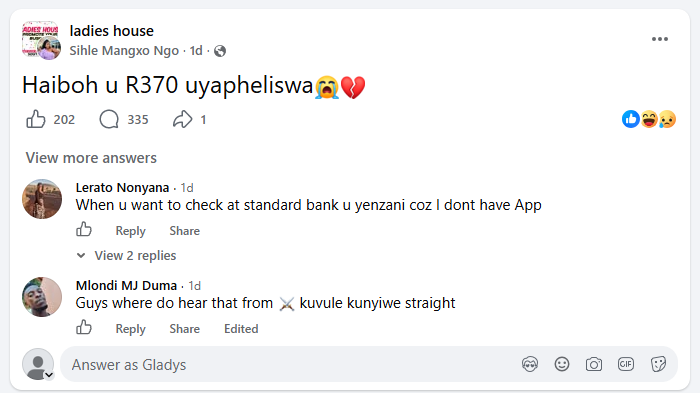
Over the past two weeks a wave of Facebook posts, WhatsApp voice notes and TikTok clips has been telling South Africans that the R370 Social Relief of Distress grant is being scrapped because of a court case. The most-shared post so far is a distressed status update reading “Haiboh u R370 uyapheliswa”. Under it, more than 300 comments from confused beneficiaries are asking whether they should even bother applying for August, and whether their September R370 will still land in the bank.
The short answer is no. There is no court order ending the R370 grant. The ruling people are talking about does the opposite of what the viral posts claim, and even that ruling is suspended and under appeal. Here is what actually happened, why the confusion spread, and how to tell a real SRD change from a chain message.
What the Court Actually Said
The judgment behind the confusion was handed down by the Gauteng Division of the High Court, Pretoria, in late 2025. The applicants were the Institute for Economic Justice and #PayTheGrants. They did not ask the court to end the SRD grant. They asked for the opposite: to strike down rules in the 2023 SRD regulations that were locking eligible people out.
The court agreed on four specific points and declared the current regulations unconstitutional and invalid. The full breakdown is in our earlier piece on the R450 court ruling, but the direction of every single finding is toward more people getting the grant, not fewer:
- Online-only applications struck down so that walk-in applications at SASSA offices become possible again.
- The R624 means-test threshold declared irrational because it has been frozen since 2022. If the ruling stands, it likely rises toward the food poverty line of about R796.
- No-new-evidence appeals rule struck down so applicants can attach fresh bank statements or affidavits when they appeal a decline.
- SASSA payment delays declared unlawful in themselves, forcing SASSA to pay approved beneficiaries within a set window.
National Treasury estimated the cost of applying that judgment at roughly R93.5 billion a year, more than double the current R36.4 billion budget line. The monthly amount would rise from R370 to about R450, in line with the food poverty line, and eligibility would widen from 8.3 million people to about 18 million. That is the ruling the viral post is misreading as “R370 is over”.
“The high court has ended the R370 grant.” Circulating on Facebook, WhatsApp and short-form video since mid-August 2026.
No court has ordered the grant to end. The judgment people are referring to would expand the grant to more people and lift the amount, not scrap it. The Department of Social Development, SASSA and the Presidency have all confirmed the R370 continues.
“My August or September R370 will not be paid.” Repeated in comment threads under the viral posts.
SASSA has already confirmed the final August 2026 SRD payment window as 24 to 26 August. Approved applicants continue to be paid on their normal batch date. The court case does not touch the monthly cycle.
“The R370 is already replaced by a new grant.” Sometimes with a link to a “registration form” asking for banking details.
The R370 SRD is funded through 31 March 2027. Only then does it convert into the Livelihoods Grant, and that transition will be announced by SASSA on official channels. No third party needs your bank details to switch you over.
Why the Court Case Does Not Actually End the Grant
Two features of the ruling get lost in the social media telephone game. Both are the reason nothing changes for beneficiaries right now.
1. The court suspended its own order for 18 months
When the High Court declared the 2023 SRD regulations invalid, it did not switch the grant off the next morning. It suspended the declaration of invalidity for 18 months. That suspension is a common tool: it gives the Department of Social Development and Treasury time to rewrite the regulations properly instead of leaving a policy vacuum. During the suspension, the existing rules continue to apply. R370 stays at R370. The R624 threshold stays at R624. The online portal stays as the only application route.
2. The state has taken the case to the Supreme Court of Appeal
On 26 August 2026 the state formally lodged its appeal against the ruling at the Supreme Court of Appeal. That appeal freezes the practical impact of the ruling further. Even if the SCA eventually sides with the applicants, the reforms would flow into the successor Livelihoods Grant framework rather than trigger a mid-cycle shutdown of the current SRD.
What “declared invalid” does not mean
In South African law, a court declaring a regulation invalid does not automatically end the programme it governs. The court usually suspends the invalidity to protect existing beneficiaries and give lawmakers time to fix the underlying rule. This is why the R370 has kept flowing every single month since the November 2025 ruling. It is also why the Livelihoods Grant framework, rather than an emergency shutdown, is where the reforms will most likely land.
The Real R370 Timeline
Here is what the R370 grant calendar actually looks like, based on the current budget, the court’s own suspension and the Livelihoods Grant transition. Every date below comes from published Treasury and Department of Social Development documents, not social media.
| Date | What actually happens | Does R370 pay? |
|---|---|---|
| 24 to 26 Aug 2026 | Final August SRD payment window for approved applicants | Yes |
| Sep 2026 to Mar 2027 | Monthly R370 cycle continues on the current budget line | Yes |
| Q4 2026 to Q2 2027 | Supreme Court of Appeal papers filed and hearing set. Suspension of High Court order continues | Yes |
| 31 Mar 2027 | Last month of the R370 SRD under its current name | Yes |
| 1 Apr 2027 | Livelihoods Grant goes live as the R370 successor with reformed rules | Replaced by Livelihoods Grant, not cancelled |
| 2027 to 2028 | Any SCA and Constitutional Court reforms are absorbed into the Livelihoods Grant regulations | Livelihoods Grant continues to pay |
Nowhere on that calendar is there a court-ordered stop, a court-ordered skipped month, or a moment where beneficiaries need to “re-register” through a link someone shared on Facebook. If any of that were coming, it would be announced through the same channels every other SASSA update uses.
How to Tell a Real SRD Update From a Chain Message
The R370 is the most-searched grant in the country, which makes it the most-faked. Real SRD announcements have a very specific shape. Chain messages do not.
- No named source. A real change is signed by SASSA, the Department of Social Development, National Treasury or the Presidency. “My cousin says” and “the group admin said” are not sources.
- No case number or gazette reference. Court rulings have citations. Regulation changes are published in the Government Gazette. A post that says “the court” without naming which court, which case or which date is guessing.
- Urgency without evidence. “Share before it’s deleted”, “the government is hiding this” and countdown timers are engagement bait, not policy.
- A link that asks for your ID, phone or banking details. Genuine SRD applications and updates only run through srd.sassa.gov.za, the SASSA WhatsApp lines (082 601 0111 for SRD self-service and 082 046 8553 for general SASSA), and USSD *120*3210#.
- A cross-check works. Real news lines up across at least two of: SASSA official social accounts, a mainstream South African newsroom (News24, SABC, Daily Maverick, GroundUp) and the grantZA latest updates feed.
- The story survives being paraphrased. Try to describe the change in your own words. If it collapses into vibes, it was vibes.
Scams already piggybacking on this myth
Two scam patterns are already in circulation off the back of the “R370 is over” posts. The first offers to “protect” your grant for a small fee via an EFT to a personal account. The second sends a fake “transition to Livelihoods Grant” form asking for your ID, banking details and phone PIN. Both are fraud. SASSA never charges to keep an existing grant active, and no transition form exists yet.
What to Do This Week
The most effective response to a wave of misinformation is to keep doing the boring, correct things. Nothing about the court case changes how you apply, how you check your status, or how you get paid.
1. Apply for September as normal. The monthly SRD application is still monthly. Skipping a month because a Facebook post said it was “over” forfeits that month’s R370 with no back-pay when the panic subsides.
2. Check your status through the official tool. Use the free SRD Status Check to confirm your current standing, and the SRD Payment Dates page for the correct batch window.
3. Do not share the “R370 is over” posts. Even if you know it is wrong, sharing to warn others still boosts the reach of the original post. A comment linking to a fact-check does the job better.
4. Report the scam links. If you receive a link claiming to “register” you for a new grant, report it to WhatsApp (long-press the message, then Report), and forward it to SASSA on 082 046 8553 so they can add it to their scam alerts.
5. Watch the real signal. The next genuine SRD change to look for is either an SCA hearing date in Q1 or Q2 2027, or the Livelihoods Grant regulations being gazetted ahead of 1 April 2027. Both will be publicly announced, and both will land on the grantZA blog the same week.
Bookmark the tools that actually confirm your grant
Don’t rely on Facebook comments for your grant news. Use the free SRD Status Check, the SRD Payment Dates page, and the main SRD grant page for eligibility, means-test rules and the correct appeals process.